

- Home
- About Us
-
Our Solution
Marketing SolutionIT solution
- Our Clients
- Our Tech
- Blogs
- Career
- Contact Us
Please fill out the form below if you have a plan or project in mind that you'd like to share with us.
Cybersecurity has evolved from an IT concern into a core business priority. Every organization—whether a startup, small business, or global enterprise—relies on digital systems to manage operations, store sensitive information, and serve customers. As businesses become more connected through cloud computing, remote work, mobile applications, and Artificial Intelligence, the attack surface for cybercriminals continues to expand.
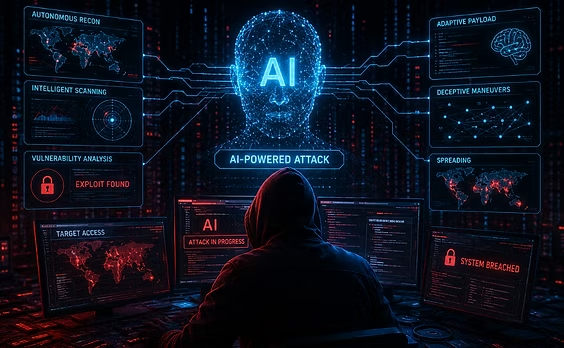
In 2026, cyber threats are more intelligent, automated, and persistent than ever before. Attackers are using AI to create convincing phishing campaigns, automate vulnerability discovery, generate sophisticated malware, and bypass traditional security measures. At the same time, defenders are leveraging AI to detect anomalies, respond to incidents, and predict emerging threats before they cause damage.
The cybersecurity landscape is no longer a battle between hackers and antivirus software. It is an ongoing race between intelligent attackers and intelligent defense systems.
For business leaders, the challenge is clear: protect digital assets without slowing innovation. Organizations that invest in proactive cybersecurity not only reduce risk but also strengthen customer trust, ensure regulatory compliance, and maintain business continuity.
This guide explores the latest cybersecurity trends, AI-powered threats, modern defense strategies, and practical steps businesses can take to build resilient security programs in 2026.
Every organization today depends on digital infrastructure.
Customer databases.
Cloud applications.
Financial systems.
Email communication.
Remote employees.
Connected devices.
Every digital asset represents both an opportunity and a potential vulnerability.
The consequences of a cyberattack can include:
Cybersecurity is no longer an expense—it's an investment in business resilience.
Cybercrime has evolved dramatically over the last decade.
Businesses primarily faced:
These attacks were often opportunistic and relatively simple.
Today's attackers use:
Modern cybercriminals operate like organized businesses, using automation, subscription-based attack tools, and even customer support for other criminals.
Artificial Intelligence has transformed both offense and defense in cybersecurity.
Attackers now use AI to:
AI can create personalized emails that mimic writing styles, company branding, and executive communication, making phishing attempts harder to detect.
Instead of manually scanning systems, AI rapidly identifies weaknesses in applications, networks, and cloud environments.
Modern malware can modify its behavior to avoid detection by traditional antivirus software.
Cybercriminals increasingly use deepfake technology to impersonate executives during financial approval requests or social engineering attacks.
AI improves password-guessing techniques by analyzing publicly available user information and behavioral patterns.
A successful attack affects more than technology.
It can disrupt:
Cybersecurity has become a board-level business issue because digital trust directly influences business success.
Traditional security assumed that users inside the network could be trusted.
Modern cybersecurity follows the Zero Trust principle:
"Never Trust. Always Verify."
Zero Trust requires continuous verification of:
Every request is authenticated and authorized, regardless of its origin.
Organizations adopting Zero Trust significantly reduce their exposure to modern cyber threats.
Cloud adoption has increased dramatically, making cloud security a top priority.
Key best practices include:
Cloud environments should be designed with security from the start rather than added later.
Remote and hybrid work have expanded the number of devices connecting to business networks.
Organizations should secure:
Modern endpoint protection platforms use AI to detect unusual behavior and isolate compromised devices before threats spread.
Ransomware remains one of the most damaging cyber threats.
Attackers encrypt business data and demand payment for its release.
A comprehensive ransomware defense includes:
Paying a ransom does not guarantee data recovery and may encourage future attacks.
While attackers use AI, defenders are doing the same.
AI-powered security platforms can:
AI enables security teams to respond faster than traditional manual processes.
Technology alone cannot prevent cyber incidents.
Employees remain a primary target for attackers.
Organizations should invest in:
A well-informed workforce is one of the strongest security defenses.
Many industries must comply with regulations such as:
Compliance helps organizations protect sensitive information while reducing legal and financial risks.
A modern cybersecurity roadmap should include:
Cybersecurity should be viewed as an ongoing process rather than a one-time project.
Businesses should monitor:
Organizations that adopt these innovations early will be better prepared for future threats.
At Niktech Solution, we help businesses build secure digital environments through proactive cybersecurity solutions designed for today's evolving threat landscape.
Our cybersecurity services include:
Our approach combines advanced technology, industry best practices, and continuous monitoring to help businesses reduce cyber risks while supporting digital innovation.
Small businesses are increasingly targeted because they often have fewer security resources. A single cyberattack can cause significant financial and reputational damage.
Yes. AI helps detect threats faster, identify unusual behavior, automate incident response, and improve overall security operations.
Zero Trust is a security model that requires continuous verification of users, devices, and applications before granting access to business resources.
Organizations should conduct regular vulnerability assessments and security audits, especially after major infrastructure changes or software updates.
AI-powered phishing, ransomware, cloud misconfigurations, and identity-based attacks remain among the most significant threats facing businesses.
Cybersecurity in 2026 is no longer just about defending networks—it is about protecting business continuity, customer trust, and long-term growth. As cybercriminals adopt Artificial Intelligence and increasingly sophisticated attack methods, organizations must move beyond reactive security measures and embrace proactive, intelligence-driven defense strategies.
From implementing Zero Trust architectures and securing cloud environments to educating employees and leveraging AI-powered threat detection, modern businesses must treat cybersecurity as a strategic investment rather than a technical afterthought.
At Niktech Solution, we partner with businesses to develop resilient cybersecurity frameworks that safeguard critical assets while enabling innovation. Our goal is to help organizations operate with confidence in an increasingly connected and complex digital world.
Cyber threats continue to evolve—but so should your security strategy.
At Niktech Solution, we deliver comprehensive cybersecurity solutions that help businesses identify vulnerabilities, strengthen defenses, ensure compliance, and respond rapidly to emerging threats.
Contact Niktech Solution today for a free cybersecurity assessment and discover how we can protect your business in the AI-powered digital era.


