

- Home
- About Us
-
Our Solution
Marketing SolutionIT solution
- Our Clients
- Our Tech
- Blogs
- Career
- Contact Us
Please fill out the form below if you have a plan or project in mind that you'd like to share with us.
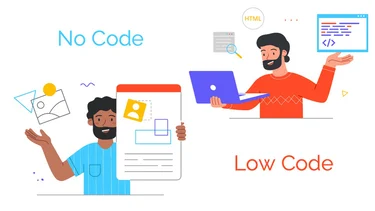
Businesses today face increasing pressure to innovate faster than ever before. Whether it's launching a customer portal, automating internal workflows, building a mobile application, or creating a CRM system, organizations need software delivered quickly without compromising quality.
Traditional software development remains essential for complex enterprise systems, but development timelines can sometimes stretch over several months.
To accelerate digital transformation, many organizations are adopting Low-Code and No-Code development platforms.
These platforms simplify application development through visual interfaces, drag-and-drop components, reusable workflows, and automation tools, allowing businesses to develop applications more rapidly.
However, while Low-Code and No-Code share similar goals, they are designed for different users and business requirements.
Understanding their strengths and limitations is critical before choosing the right solution.
This guide explores everything businesses need to know about Low-Code and No-Code development in 2026.
Low-Code development uses visual development environments while still allowing developers to write custom code whenever needed.
Instead of coding every feature from scratch, developers use pre-built components, templates, APIs, and workflow builders.
Low-Code is ideal for:
Developers maintain flexibility while reducing development time.
No-Code platforms allow users with little or no programming knowledge to build applications using visual tools.
Business users can create:
No-Code empowers non-technical teams to solve everyday business challenges independently.
| Feature | Low-Code | No-Code |
|---|---|---|
| Coding Required | Minimal | None |
| Target Users | Developers & IT Teams | Business Users |
| Customization | High | Limited |
| Scalability | Excellent | Moderate |
| Enterprise Support | Excellent | Limited |
| Development Speed | Fast | Very Fast |
| API Integration | Extensive | Basic to Moderate |
| Best For | Complex Business Applications | Simple Business Apps |
Organizations using Low-Code often gain:
Applications can be delivered weeks faster than traditional coding.
Reusable components reduce engineering effort.
Low-Code platforms support complex applications and integrations.
Business stakeholders and developers can work together more effectively.
Developers can extend applications with custom code when required.
No-Code enables businesses to:
For many internal business processes, No-Code provides an efficient solution.
Businesses should also understand the constraints.
Evaluating long-term scalability is essential before choosing a platform.
Application security remains critical regardless of the development approach.
Businesses should implement:
Proper governance helps protect business data and maintain regulatory compliance.
Choose Low-Code if your organization needs:
Choose No-Code if your goal is:
Many organizations successfully combine both approaches as part of their digital transformation strategy.
The future of Low-Code and No-Code includes:
These innovations will further reduce development time while expanding application capabilities.
At Niktech Solution, we help businesses accelerate digital transformation by delivering the right development approach for every project.
Our services include:
We assess your business goals, technical requirements, and scalability needs to recommend the most effective development strategy.
Low-Code platforms require minimal programming and are designed for developers, while No-Code platforms allow non-technical users to create applications without writing code.
Yes. Low-Code platforms are widely used to develop scalable enterprise applications with custom integrations and advanced business logic.
No. While No-Code is excellent for simple applications and automation, complex enterprise systems often require custom software development.
They can be, provided they are implemented with strong security practices, access controls, encryption, and compliance measures.
Yes. We evaluate your business objectives and recommend the best combination of traditional development, Low-Code, or No-Code solutions to maximize efficiency and long-term value.
Low-Code and No-Code development platforms are reshaping the way businesses build software by reducing development time, empowering teams, and accelerating digital transformation. While No-Code enables rapid creation of simple business applications, Low-Code provides the flexibility and scalability required for enterprise-grade solutions.
The best choice depends on your organization's technical requirements, growth plans, and long-term business goals.
At Niktech Solution, we help businesses identify the right development strategy, implement scalable applications, and integrate modern technologies that support innovation, efficiency, and sustainable growth.
Whether you're building an enterprise platform or automating internal workflows, choosing the right development approach can save time, reduce costs, and improve business agility.
Niktech Solution delivers custom software, Low-Code, and No-Code solutions tailored to your organization's unique requirements.
Contact Niktech Solution today for a free consultation and discover the fastest path to digital transformation.


