

- Home
- About Us
-
Our Solution
Marketing SolutionIT solution
- Our Clients
- Our Tech
- Blogs
- Career
- Contact Us
Please fill out the form below if you have a plan or project in mind that you'd like to share with us.
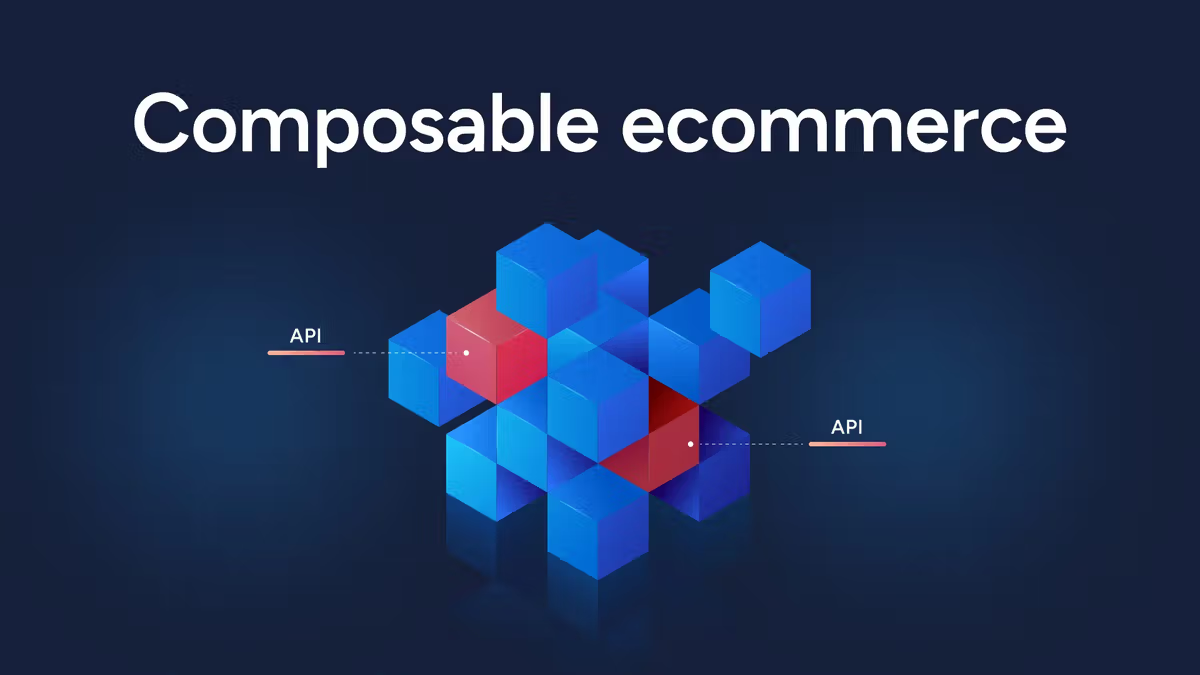
The digital commerce landscape is evolving rapidly. Modern consumers expect personalized shopping experiences, seamless omnichannel interactions, lightning-fast performance, and continuous innovation. Traditional monolithic eCommerce platforms often struggle to meet these expectations due to limited flexibility and slower development cycles.
To address these challenges, businesses are increasingly adopting Composable Commerce.
Composable Commerce is a modular approach to eCommerce where businesses build their digital commerce ecosystem using best-of-breed components connected through APIs. Instead of relying on a single all-in-one platform, organizations can select specialized services for product management, payments, search, checkout, customer engagement, and analytics.
In 2026, Composable Commerce is transforming how enterprises build scalable, adaptable, and customer-centric online experiences. By embracing microservices, API-first design, cloud-native infrastructure, and headless architecture, businesses gain the agility to innovate faster and respond to changing market demands.
This guide explores Composable Commerce, its architecture, benefits, implementation strategies, industry applications, challenges, and future trends.
Composable Commerce is an architectural approach that allows businesses to assemble their eCommerce platform using independent, interchangeable software components.
Instead of depending on one vendor for every feature, businesses integrate specialized services through APIs.
Common components include:
Modern composable platforms are built on the MACH principles:
Applications are divided into independent services that can be developed, deployed, and updated separately.
Every service communicates through secure APIs, enabling seamless integrations.
Applications are optimized for cloud environments, improving scalability and resilience.
The frontend is decoupled from the backend, allowing businesses to deliver personalized experiences across websites, mobile apps, kiosks, and marketplaces.
| Traditional Platform | Composable Commerce |
|---|---|
| Monolithic architecture | Modular architecture |
| Limited flexibility | Highly customizable |
| Vendor lock-in | Best-of-breed solutions |
| Slower updates | Independent deployments |
| Difficult integrations | API-driven integrations |
| Single frontend | Omnichannel experiences |
Organizations adopting Composable Commerce can achieve:
Deliver personalized shopping experiences across web, mobile, and in-store channels.
Support complex pricing, custom catalogs, and business-specific purchasing workflows.
Enable secure online ordering for medical supplies and healthcare products.
Create digital product catalogs and dealer portals.
Offer AI-driven product recommendations, virtual try-ons, and personalized promotions.
Manage inventory, online ordering, and delivery services in real time.
Composable Commerce relies on:
Businesses should prepare for:
A phased migration strategy helps reduce risks and ensures successful adoption.
Composable Commerce continues to evolve with:
At Niktech Solution, we help businesses build scalable, secure, and future-ready digital commerce platforms using modern software architectures.
Our expertise includes:
We create flexible commerce ecosystems that help businesses innovate faster and deliver exceptional customer experiences.
Composable Commerce is a modular approach to building eCommerce platforms using independent services connected through APIs.
Traditional platforms bundle all features together, while Composable Commerce lets businesses choose and integrate specialized components based on their needs.
Retailers, B2B organizations, manufacturers, healthcare providers, marketplaces, and enterprises with complex digital commerce requirements.
It can be, but it's especially valuable for growing businesses and enterprises that require flexibility, scalability, and omnichannel capabilities.
Yes. We provide custom eCommerce development, headless commerce, API integration, cloud-native architecture, and ongoing support to help businesses build modern digital commerce platforms.
Composable Commerce is redefining the future of digital retail by giving businesses the flexibility to innovate without being constrained by monolithic platforms. Through modular architecture, API-first design, and cloud-native technologies, organizations can create scalable, personalized, and future-ready shopping experiences.
As customer expectations continue to evolve, adopting Composable Commerce will enable businesses to stay competitive, accelerate innovation, and adapt to changing market demands.
At Niktech Solution, we help businesses design and implement next-generation commerce platforms that drive growth, improve customer engagement, and support long-term digital transformation.
Transform your online business with a flexible, scalable, and intelligent eCommerce platform.
Partner with Niktech Solution for Composable Commerce architecture, custom software development, cloud integration, and API-driven digital experiences.
Contact Niktech Solution today for a free consultation and build an eCommerce platform ready for the future.


